
Cybersecurity protects a company’s ability to operate, meet commitments and make trustworthy decisions. Attacks can stop operations, redirect payments, expose data or damage trust; security reduces the likelihood and impact of those scenarios.
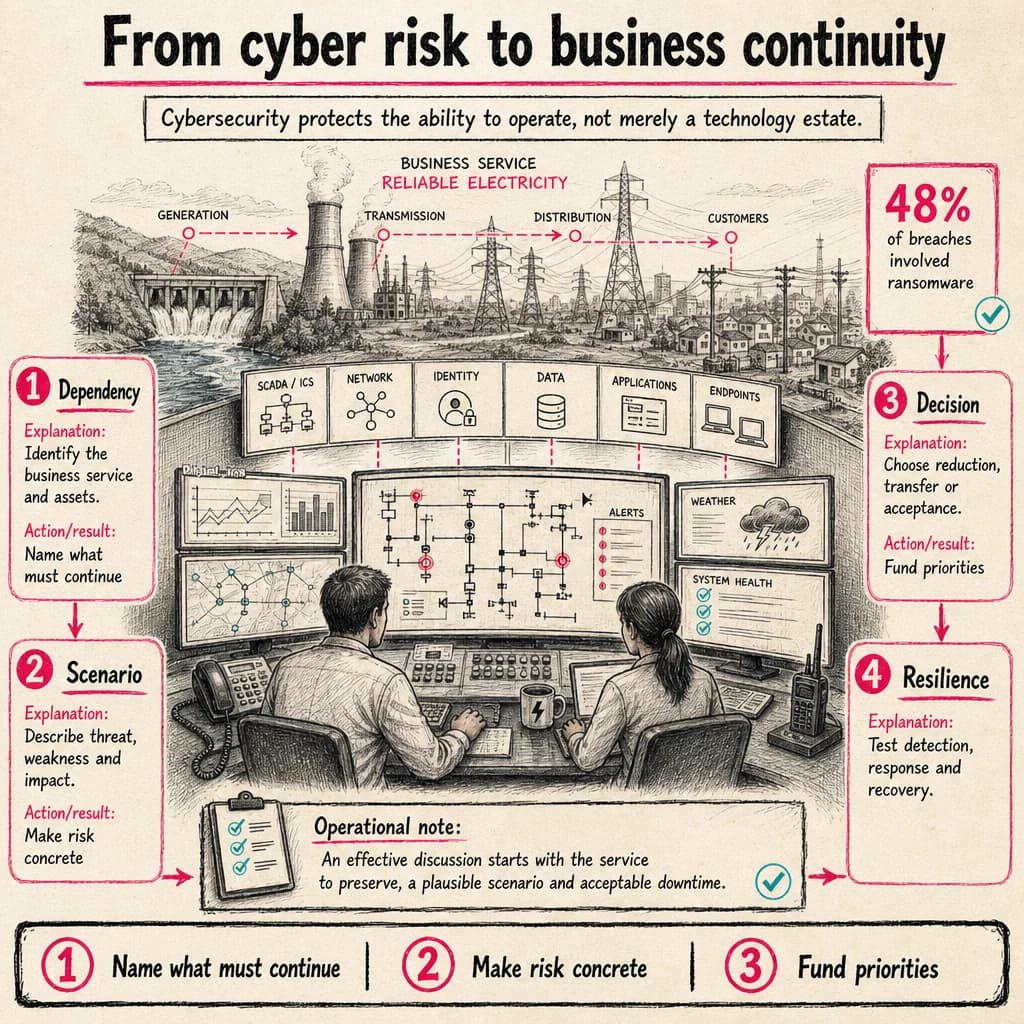
of breaches involved ransomware
Verizon’s 2026 DBIR found ransomware in 48% of breaches in its dataset. The benchmark supports prioritizing backups, identity, segmentation and response readiness.
Verizon — 2026 Data Breach Investigations ReportStart from services the business must maintain
Identify processes whose outage affects customers, safety, cash flow or obligations. Connect each to required applications, identities, suppliers and data. This map makes cyber risk concrete.
The same vulnerability has different priority on an isolated lab and the system authorizing payments. Context turns a weakness into a decision.
Trust rests on verifiable capabilities
Customers and partners expect controlled access, protected data and managed incidents. Policies alone do not demonstrate that capability. Tested recovery, timely revocation, available logs and assessed suppliers do.
Being transparent internally about limitations also enables investment choices instead of promises of perfect protection.
Prioritize by scenario and option
Present a scenario, impact, current controls, gap and two or three options. For each, show expected risk reduction, operating cost, dependencies and timing. Leaders can then decide on a common basis.
A priority needs an owner and review date to remain actionable.
Foundations that reduce many risks
Inventory, strong identity, exposure reduction, segmentation, tested backups, logging and crisis exercises interrupt multiple attack chains. Operational quality matters more than accumulating disconnected tools.
- Know assets and owners
- Protect identity and privilege
- Reduce exposure
- Detect and contain
- Recover and learn
Operational decision matrix
| Stage | Question to resolve | Expected outcome |
|---|---|---|
| Dependency | Identify the business service and assets. | Name what must continue |
| Scenario | Describe threat, weakness and impact. | Make risk concrete |
| Decision | Choose reduction, transfer or acceptance. | Fund priorities |
Speak to the business
An effective discussion starts with the service to preserve, a plausible scenario and acceptable downtime.
The right control level depends on context, exposed assets and business impact: document assumptions, measure the outcome and reassess after every material change.
Frequently asked questions
Is cybersecurity only an IT responsibility?
No. Business units, procurement, HR, finance, legal and leadership all own essential decisions and dependencies.
How should cyber budget be explained?
Map investment to a scenario, risk reduction, operational trade-off and measurable outcome.
Can all cyber risk be eliminated?
No. The goal is to reduce and manage risk according to organizational priorities and tolerance.
Official sources
Achraf Hachimi
CISSP-certified Senior SOC / CSIRT Engineer specializing in Incident Response, Threat Hunting and Detection Engineering. Eight years of experience in critical environments with Splunk ES, Microsoft Defender XDR, SentinelOne and Cybereason.