
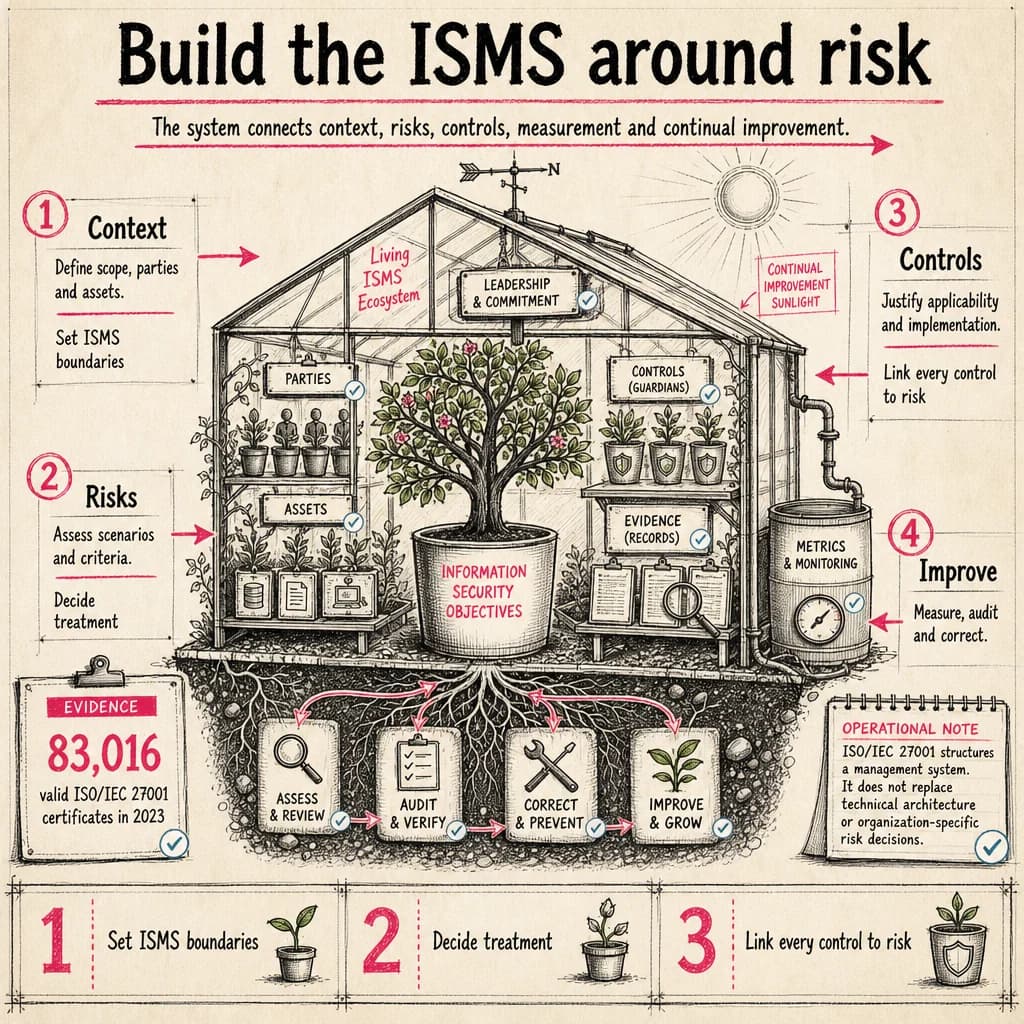
ISO/IEC 27001:2022 defines requirements for an information security management system, or ISMS. An organization scopes the system, assesses risk, selects and operates treatments, measures results and improves the system over time.
valid ISO/IEC 27001 certificates in 2023
ISO research published in 2026 reports 83,016 valid certificates across 165 countries in 2023, up from 4,073 in 2006. Certification still does not guarantee a fixed security level.
ISO — Research Grant 2024 / ISO SurveyISO 27001 organizes security decisions
The standard is not just a list of technical controls. It requires an organization to understand context, interested parties, accountability, risk and how it checks that the system works.
A strong ISMS links business objectives to observable decisions. Scope, assets, owners and risk criteria must be specific enough for teams to act when gaps appear.
Move from risk to treatment
Use a repeatable method for identification, analysis, evaluation and acceptance. Treatment may reduce, avoid, transfer or accept risk. Preserve the scenario, owner, target and deadline behind every decision.
Annex A helps check necessary controls, but selection starts from risk and applicable requirements. Copying every control without rationale creates paperwork without priority.
Use the Statement of Applicability as a decision map
The Statement of Applicability records selected controls, rationale, implementation status and exclusions. It becomes useful when it points to operational ownership and evidence.
Maintain it when architecture, organization or threat conditions change. A statement frozen between audits quickly loses contact with reality.
Operate the management loop
Internal audits, incidents, metrics and management review drive correction and improvement. Use decision metrics such as asset coverage, expired exceptions, late remediation, test results and critical-control availability.
- Context and scope decided
- Risks owned
- Treatments planned
- Controls operated and measured
- Gaps corrected and retested
Operational decision matrix
| Stage | Question to resolve | Expected outcome |
|---|---|---|
| Context | Define scope, parties and assets. | Set ISMS boundaries |
| Risks | Assess scenarios and criteria. | Decide treatment |
| Controls | Justify applicability and implementation. | Link every control to risk |
What the standard changes
ISO/IEC 27001 structures a management system. It does not replace technical architecture or organization-specific risk decisions.
The right control level depends on context, exposed assets and business impact: document assumptions, measure the outcome and reassess after every material change.
Frequently asked questions
Is ISO 27001 a technical standard?
It is a management-system standard governing how an organization manages information-security risks and controls.
Must every Annex A control be implemented?
The organization selects necessary controls based on risk and justifies inclusion and exclusion in the Statement of Applicability.
Can ISO 27001 be used without certification?
Yes. Organizations can use its requirements to structure an ISMS without immediately seeking certification.
Official sources
Achraf Hachimi
CISSP-certified Senior SOC / CSIRT Engineer specializing in Incident Response, Threat Hunting and Detection Engineering. Eight years of experience in critical environments with Splunk ES, Microsoft Defender XDR, SentinelOne and Cybereason.