
Useful cyber governance is not about producing documents in isolation. It must drive decisions, clarify accountability and accelerate implementation where risk is real.
The link between policy, architecture, operations and compliance is what keeps critical environments coherent over time.
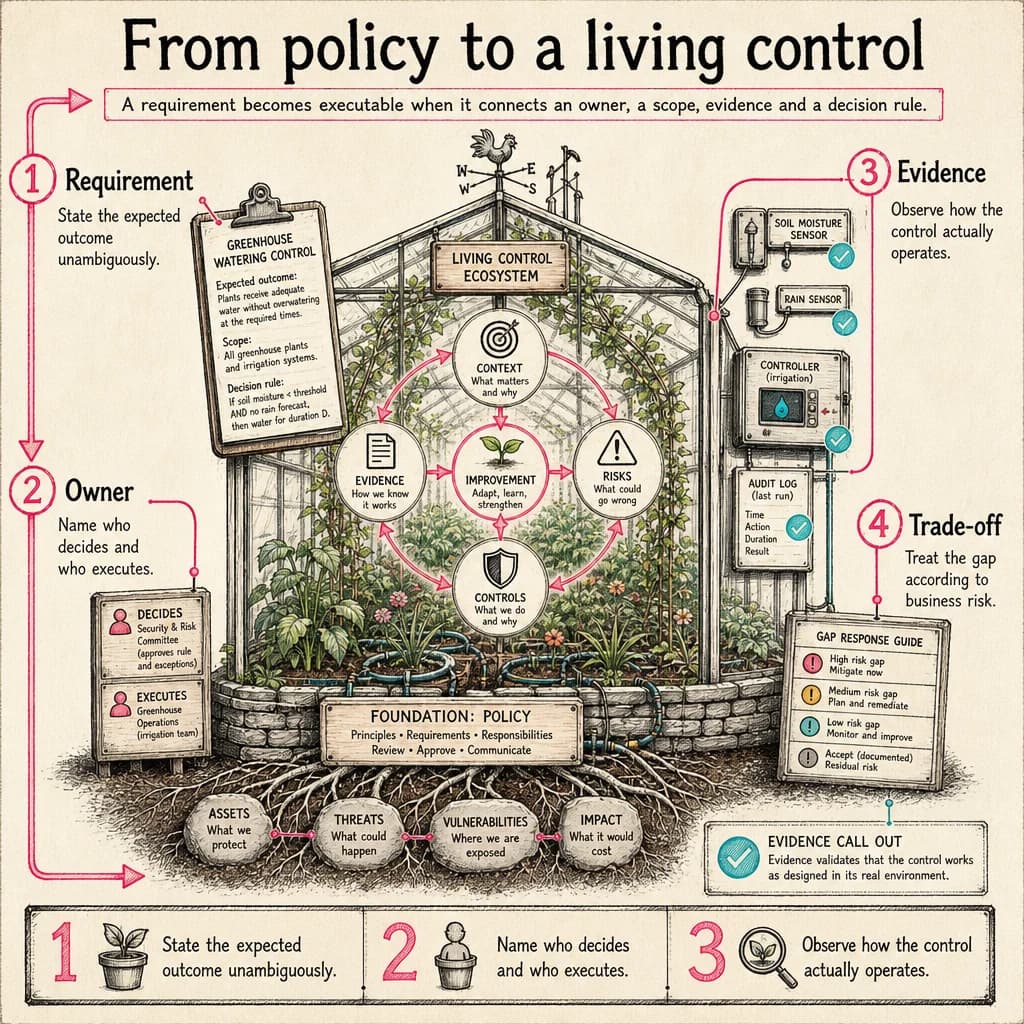
A policy becomes executable when each requirement has an owner, a scope, expected evidence and a decision rule for exceptions. Without those elements, teams interpret the same sentence differently and committees learn too late that declared compliance does not match the way systems actually operate.
Governance should distinguish reversible decisions from structural trade-offs. A temporary exception, an accepted risk and architecture debt do not require the same treatment. Recording an expiry date, an accountable owner and conditions for review prevents a provisional choice from becoming a permanent and invisible weakness.
Metrics are more useful when they connect exposure to the ability to act. Counting published policies or declared controls provides an administrative view. Tracking assets without ownership, missing log sources, overdue remediation and critical dependencies without fallback options gives leaders information that can guide concrete priorities.
A steering committee does not need every technical detail. It needs a concise decision package: risk, plausible scenarios, options, operational costs, limits and the decision required. The supporting evidence must remain accessible, however, so that executive simplification never becomes a distortion of the technical reality.
The operating rhythm matters as much as the documents. Regular risk-owner reviews, expiring exceptions and closure tests keep decisions current as services, suppliers and threat conditions change.
Achraf Hachimi
CISSP-certified Senior SOC / CSIRT Engineer specializing in Incident Response, Threat Hunting and Detection Engineering. Eight years of experience in critical environments with Splunk ES, Microsoft Defender XDR, SentinelOne and Cybereason.