
A strong incident response drill confronts a team with a plausible scenario, incomplete evidence and timestamped decisions. It tests real dependencies such as access, logs, contacts and authority, then turns each gap into a verifiable improvement.
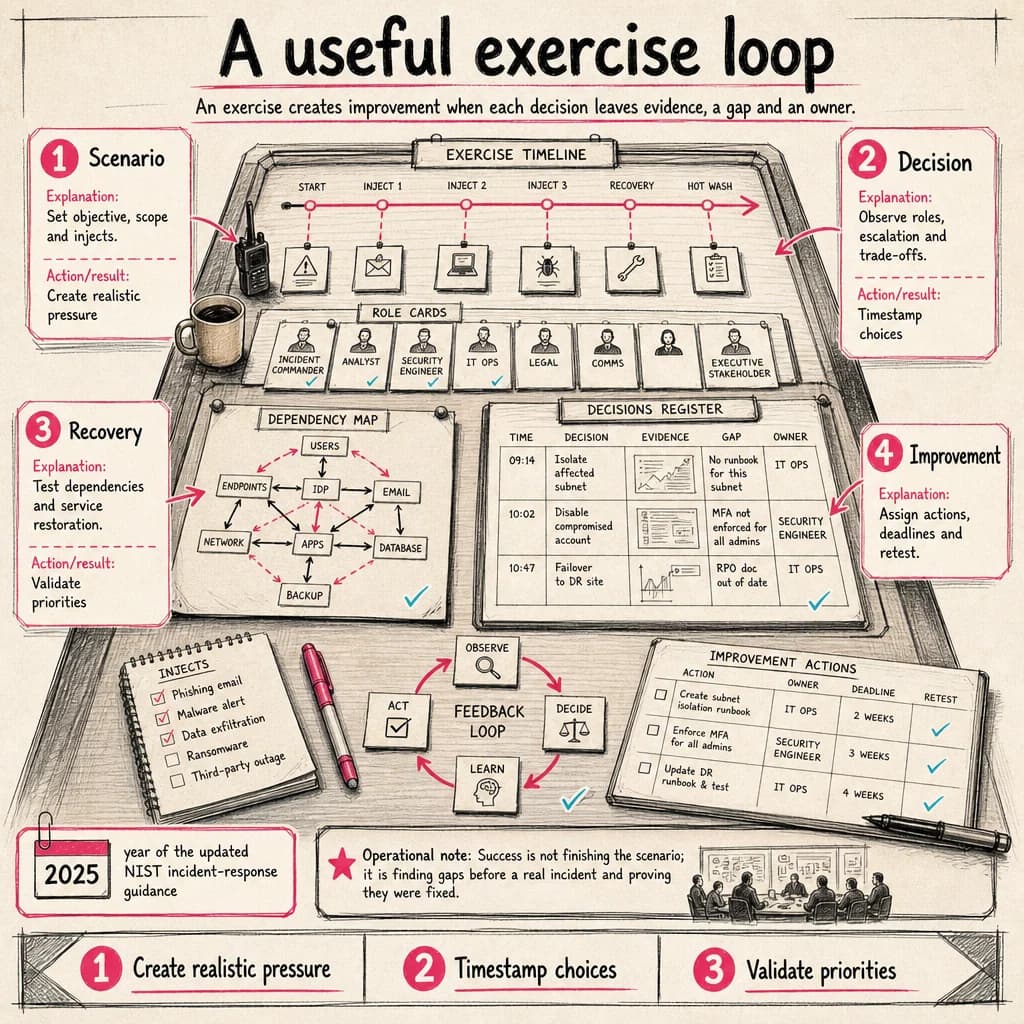
year of the updated NIST incident-response guidance
SP 800-61 Rev. 3, published in April 2025, integrates incident response across CSF 2.0 risk management instead of treating it as an isolated phase.
NIST — SP 800-61 Rev. 3Define one testable objective
Avoid the vague goal of “testing the plan.” Select a capability: revoke a compromised account, isolate a critical host, decide on service shutdown or coordinate notification. State participants, scope and stop conditions.
Build the scenario around a business asset and impact. Technical details matter only when they cause a decision or expose a dependency.
Write injects as a timeline
Each inject delivers a signal such as an EDR alert, user call, cloud sign-in or outage. Record simulated time, recipient, known facts and expected decision. Add one realistic contradiction to test uncertainty management.
Do not reveal the solution. Observe where the team seeks information, who owns authority and how assumptions are recorded.
Measure what determines the outcome
Time qualification, escalation and containment, but also assess scope clarity, evidence preservation, consequence analysis and communication. Fast but untraceable action can damage the later response.
- Time to qualification
- Time to decision owner
- Access actually available
- Scope accuracy
- Decision and assumption log
Close gaps with another test
Separate missing procedure, unavailable tool, skill gap and unassigned authority. Every action gets an owner and verification condition.
Replay the affected step after correction. Updated documentation does not prove the access works under pressure.
Operational decision matrix
| Stage | Question to resolve | Expected outcome |
|---|---|---|
| Scenario | Set objective, scope and injects. | Create realistic pressure |
| Decision | Observe roles, escalation and trade-offs. | Timestamp choices |
| Recovery | Test dependencies and service restoration. | Validate priorities |
Measure differently
Success is not finishing the scenario; it is finding gaps before a real incident and proving they were fixed.
The right control level depends on context, exposed assets and business impact: document assumptions, measure the outcome and reassess after every material change.
Frequently asked questions
How long should a drill last?
A focused tabletop may take 60–90 minutes; a full technical exercise takes longer. The objective determines duration.
Should participants be warned?
For a first exercise, explain the framework and rules. Surprise is useful only when it serves a controlled objective.
Which scenario should we choose?
Choose one threatening a critical service and exposing a dependency the organization genuinely needs to test.
Official sources
Achraf Hachimi
CISSP-certified Senior SOC / CSIRT Engineer specializing in Incident Response, Threat Hunting and Detection Engineering. Eight years of experience in critical environments with Splunk ES, Microsoft Defender XDR, SentinelOne and Cybereason.