
Security Information and Event Management technology centralizes, normalizes, searches and correlates security events to support detection and investigation. It becomes operational only when sources are reliable, rules map to scenarios and every alert supports a documented decision.
year of the updated NIST incident-response guidance
SP 800-61 Rev. 3, published in April 2025, integrates incident response across CSF 2.0 risk management instead of treating it as an isolated phase.
NIST — SP 800-61 Rev. 3What a SIEM does — and does not do
A SIEM connects identity, endpoint, network, cloud and application records so analysts can search across them. It accelerates investigation when a signal carries user, asset and historical context.
It cannot invent missing telemetry and does not replace EDR or incident responders. An expensive license with weak collection governance mainly creates cost and noise.
The minimum architecture to decide
Map producers, collectors, transport, normalization, hot and cold storage and consumers. For each source, define an owner, timezone, retention, critical fields, access rules and failure behavior.
A stable model for users, hosts and applications matters more than connector count because it enables correlation without rebuilding identity mappings each time.
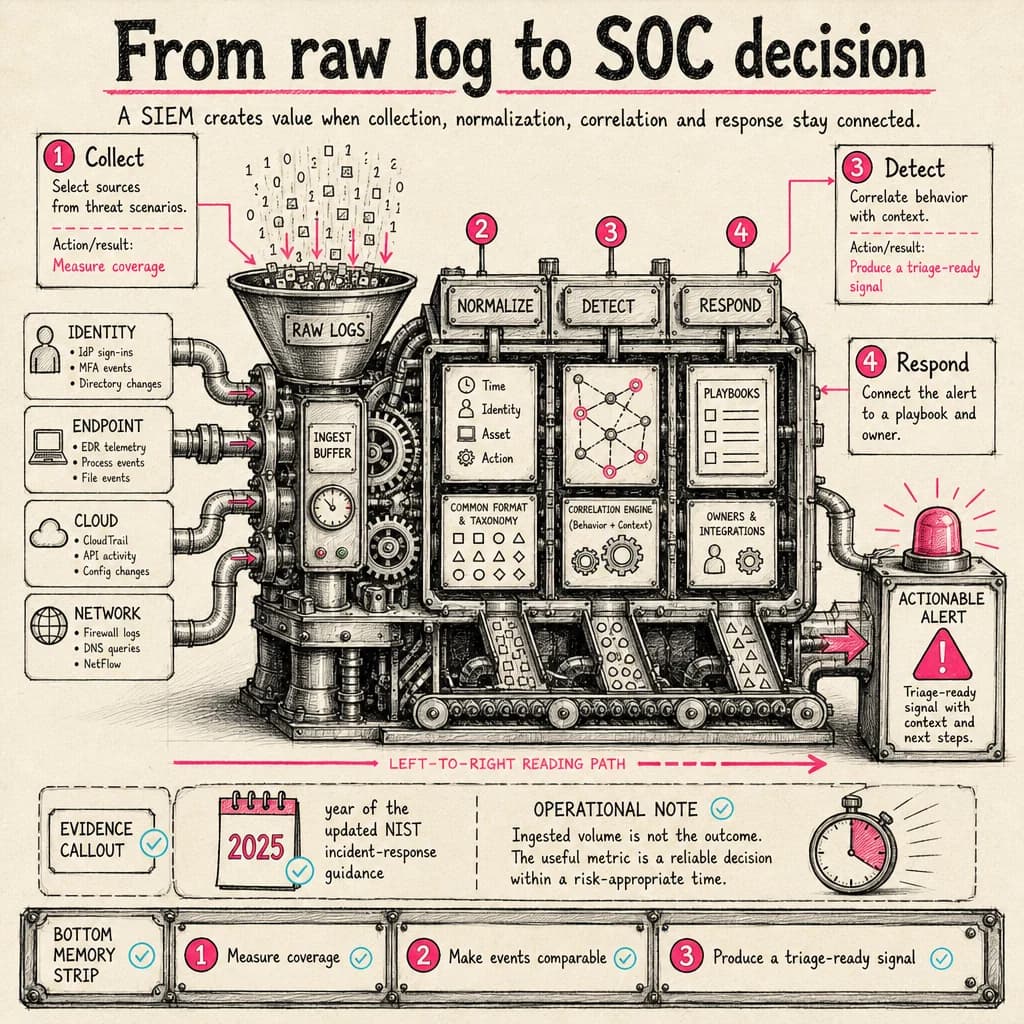
Prioritize use cases
Start with scenarios combining impact, likelihood and available telemetry. Define behavior, logic, exceptions, triage, ownership and testing. A rule without a next action is a query, not an operational use case.
- Threat scenario and asset
- Required sources and fields
- Logic and thresholds
- Analyst context
- Action, escalation and test
Measure quality, not volume
Track source availability, tested coverage, triage time, costly false positives and incidents first found elsewhere. These metrics show where the detection chain fails.
Rule and event counts help with capacity but do not prove the SOC detects earlier or decides better.
Operational decision matrix
| Stage | Question to resolve | Expected outcome |
|---|---|---|
| Collect | Select sources from threat scenarios. | Measure coverage |
| Normalize | Preserve time, identity, asset and action. | Make events comparable |
| Detect | Correlate behavior with context. | Produce a triage-ready signal |
Architecture criterion
Ingested volume is not the outcome. The useful metric is a reliable decision within a risk-appropriate time.
The right control level depends on context, exposed assets and business impact: document assumptions, measure the outcome and reassess after every material change.
Frequently asked questions
What is the difference between SIEM and EDR?
EDR observes and acts on endpoints; SIEM correlates many sources across the environment. They are complementary.
Should every log enter the SIEM?
No. Collection should support defined detection, investigation, compliance or retention needs.
Where should a SIEM project start?
With priority scenarios, required sources and expected decisions before evaluating connector catalogs.
Official sources
Achraf Hachimi
CISSP-certified Senior SOC / CSIRT Engineer specializing in Incident Response, Threat Hunting and Detection Engineering. Eight years of experience in critical environments with Splunk ES, Microsoft Defender XDR, SentinelOne and Cybereason.