
Ransomware is an extortion operation that encrypts systems, steals data or combines both. Effective response begins before the ransom note by detecting initial access, abnormal privilege, defense evasion and lateral movement.
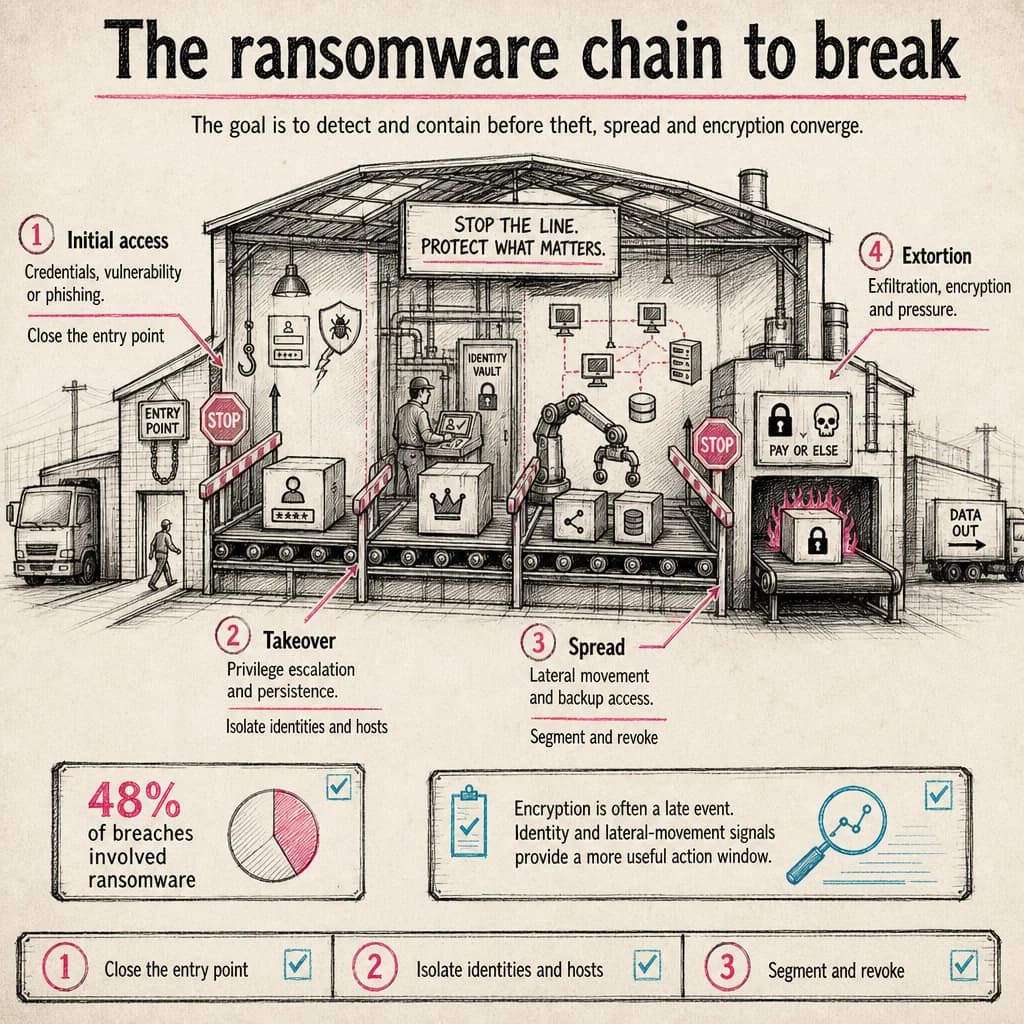
of breaches involved ransomware
Verizon’s 2026 DBIR found ransomware in 48% of breaches in its dataset. The benchmark supports prioritizing backups, identity, segmentation and response readiness.
Verizon — 2026 Data Breach Investigations ReportRansomware is a chain, not one binary
Incidents often begin with compromised credentials, an exposed service, a vulnerability or email. The intruder establishes persistence, explores identity infrastructure, gains privilege, steals data and attacks backups before encryption.
Waiting for renamed files means detecting the final impact. Earlier opportunities include unusual sign-ins, remote administration, account creation, broad share access and coordinated security-agent shutdown.
Signals the SOC should correlate
One event may be legitimate; a sequence tells the story. Connect identity, endpoint, network, cloud and backup telemetry into one timeline.
- New-origin authentication
- Privilege elevation and account creation
- Lateral or remote administration
- High-volume exfiltration
- Backup and defense tampering
Decisions in the first hours
Isolate affected hosts without blindly shutting down the estate. Protect backups and administrative accounts, preserve evidence and identify scope before recovery. If activity continues, emergency segmentation and targeted service suspension may reduce impact.
Activate crisis governance in parallel: leadership, legal, business owners, communications and response partners. Maintain a timestamped decision log and mark uncertain assumptions clearly.
Recover without bringing the attacker back
Restore from a trusted environment after rotating secrets and fixing initial access. Prioritize services by business dependencies, validate backups and heighten monitoring during reconnection.
The review should create testable changes to administration paths, logging, backup procedures and decision exercises.
Operational decision matrix
| Stage | Question to resolve | Expected outcome |
|---|---|---|
| Initial access | Credentials, vulnerability or phishing. | Close the entry point |
| Takeover | Privilege escalation and persistence. | Isolate identities and hosts |
| Spread | Lateral movement and backup access. | Segment and revoke |
Response priority
Encryption is often a late event. Identity and lateral-movement signals provide a more useful action window.
The right control level depends on context, exposed assets and business impact: document assumptions, measure the outcome and reassess after every material change.
Frequently asked questions
Should an affected machine be powered off?
Network isolation is often the first move; shutdown may destroy volatile evidence. Follow the response playbook.
Are backups enough?
No. They must be isolated, tested and restorable, and the initial access path must be fixed.
Does ransomware always encrypt files?
No. Some operations rely mainly on data theft and publication threats.
Official sources
Achraf Hachimi
CISSP-certified Senior SOC / CSIRT Engineer specializing in Incident Response, Threat Hunting and Detection Engineering. Eight years of experience in critical environments with Splunk ES, Microsoft Defender XDR, SentinelOne and Cybereason.