
Shadow AI is the use of AI tools or models without sufficient organizational approval or visibility. Risk comes from submitted data, produced decisions, integrations and missing ownership—not merely from the AI label.
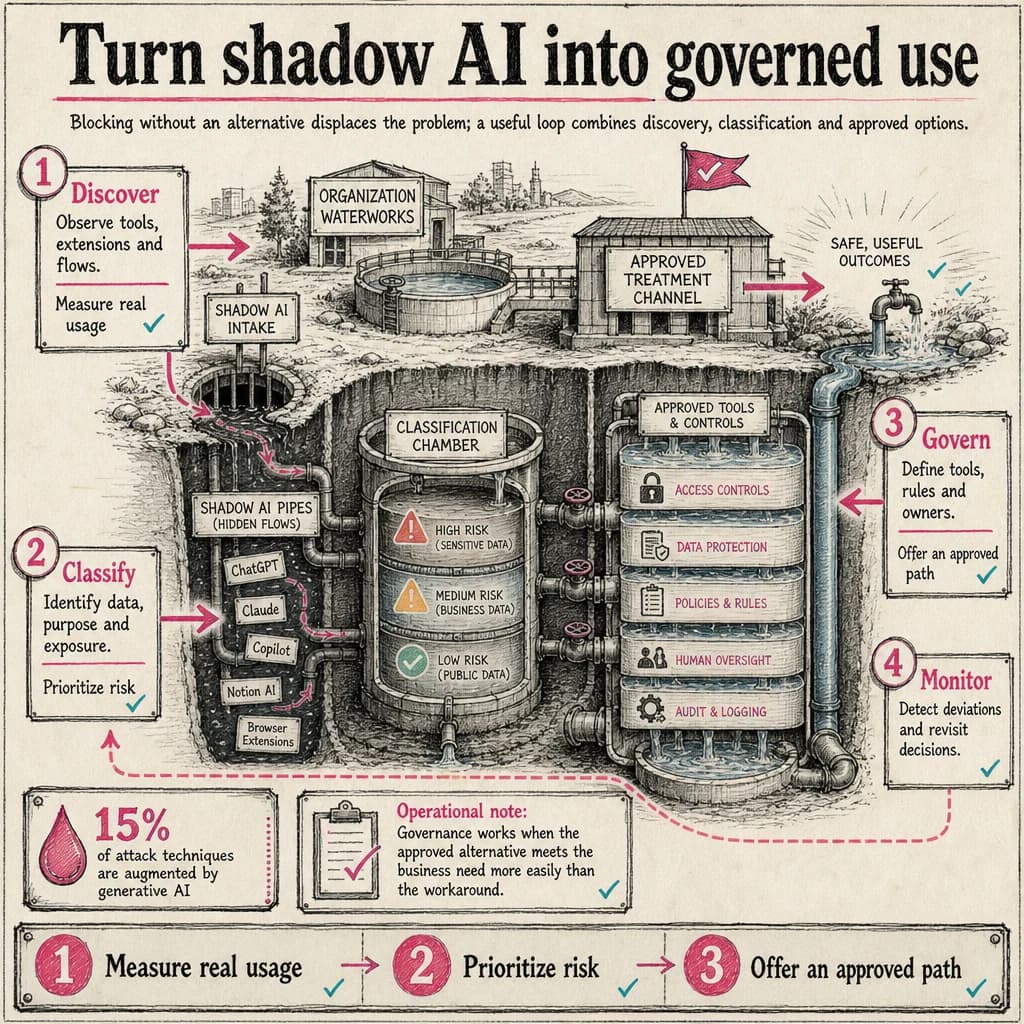
of attack techniques are augmented by generative AI
The 2026 DBIR observes generative AI being used to accelerate multiple attack techniques. Governance must cover internal use while accounting for this threat shift.
Verizon — 2026 Data Breach Investigations ReportWhy people route around policy
Employees usually pursue a real gain: summarizing, coding, translating or analyzing. A ban without an alternative pushes work into personal accounts and reduces visibility. First understand the task, data and desired output.
Separate isolated experimentation, individual assistance and decisions embedded in critical processes. Their risks and controls differ.
Build a data-flow inventory
Record the tool, provider, account, input data, outputs, retention, possible training and system connections. Add the business owner and dependency level.
Combine simple declaration, spend analysis, SaaS logs and network observations. Prioritize sensitive flows instead of waiting for a perfect list.
Create fast decision paths
Offer three routes: approved tools for defined data, isolated experiments with non-sensitive data, and stronger review for integration or important decisions. Publish concrete examples of allowed inputs.
The approved alternative must be usable. A multi-week approval for daily work leaves the control theoretical.
Monitor risk over time
Models, terms and features change. Review when integrations, data or production status change. Evaluate outputs for error, vulnerable code, disclosure and unsupervised automation.
- Data and purpose
- Account and provider
- Retention and training
- Integrations and permissions
- Human validation and recourse
Operational decision matrix
| Stage | Question to resolve | Expected outcome |
|---|---|---|
| Discover | Observe tools, extensions and flows. | Measure real usage |
| Classify | Identify data, purpose and exposure. | Prioritize risk |
| Govern | Define tools, rules and owners. | Offer an approved path |
Pragmatic approach
Governance works when the approved alternative meets the business need more easily than the workaround.
The right control level depends on context, exposed assets and business impact: document assumptions, measure the outcome and reassess after every material change.
Frequently asked questions
Is Shadow AI always prohibited?
No. It primarily signals insufficient visibility or approval. Some uses can be regularized with proportionate controls.
Should all public AI tools be blocked?
Blocking can reduce exposure, but approved options and concrete rules are needed to prevent workarounds.
What data should never be submitted?
Any data prohibited by classification or contract, including secrets, sensitive personal data or confidential code without authorization.
Official sources
Achraf Hachimi
CISSP-certified Senior SOC / CSIRT Engineer specializing in Incident Response, Threat Hunting and Detection Engineering. Eight years of experience in critical environments with Splunk ES, Microsoft Defender XDR, SentinelOne and Cybereason.