
Social engineering manipulates a person into disclosing information, granting access or taking action. It uses authority, urgency, reciprocity or fear across email, phone, messaging, social networks and physical contact.
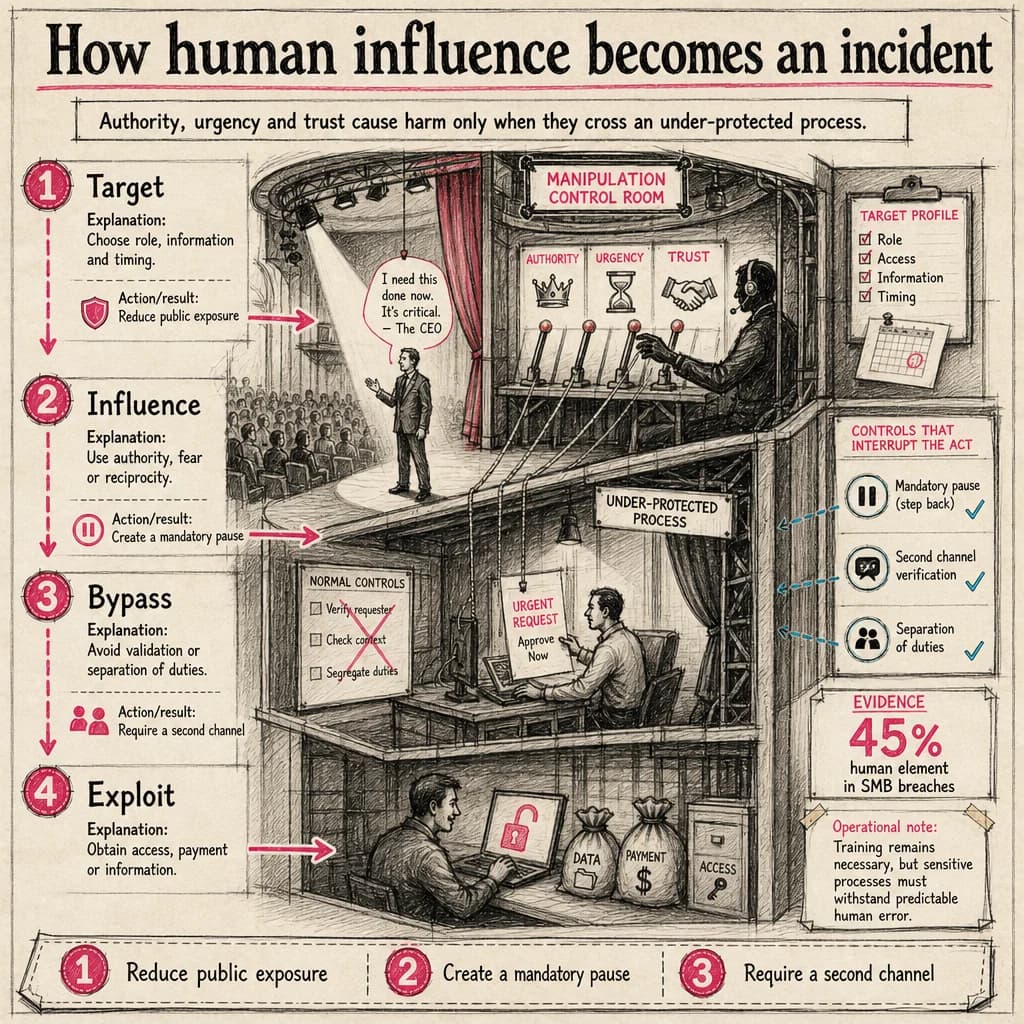
human element in SMB breaches
The SMB analysis in the 2026 DBIR attributes a human element to 45% of observed breaches. Defense must combine process, identity, email controls and reporting.
Verizon — 2026 Data Breach Investigations ReportTechniques beyond phishing
Vishing uses voice, smishing uses text messages, pretexting builds a credible story and tailgating exploits physical access. One attack may combine Teams, a fake helpdesk call and an MFA prompt.
Public information supplies credibility. A job title, announcement or out-of-office reply can make the pretext feel familiar.
Detect the process break
The strongest signals are requests that change channels, rush a control, isolate the target or demand an exception. Legitimate authority should not need to remove verification rules.
Give employees explicit permission to pause and call back through a trusted directory.
Build controls that survive persuasion
Dual payment approval, time-bound access, phishing-resistant MFA and helpdesk procedures limit the consequence of human error. The controls must also apply to executives and emergencies.
Support teams need verification scripts and escalation when a caller claims to have lost every factor.
Train decisions rather than fear
Vary channels and target exposed roles such as finance, HR, support and engineering. Measure reporting, out-of-band validation and information quality.
Explain the persuasion mechanism and expected control after each exercise so the lesson transfers to a new scenario.
Operational decision matrix
| Stage | Question to resolve | Expected outcome |
|---|---|---|
| Target | Choose role, information and timing. | Reduce public exposure |
| Influence | Use authority, fear or reciprocity. | Create a mandatory pause |
| Bypass | Avoid validation or separation of duties. | Require a second channel |
Beyond awareness
Training remains necessary, but sensitive processes must withstand predictable human error.
The right control level depends on context, exposed assets and business impact: document assumptions, measure the outcome and reassess after every material change.
Frequently asked questions
Is social engineering always digital?
No. It can use phones, physical visits, letters or several channels together.
Is awareness training enough?
No. Technical and business controls must limit the impact of a mistake.
What is the strongest warning sign?
A request to bypass an established procedure, especially when combined with urgency, secrecy or authority.
Official sources
Achraf Hachimi
CISSP-certified Senior SOC / CSIRT Engineer specializing in Incident Response, Threat Hunting and Detection Engineering. Eight years of experience in critical environments with Splunk ES, Microsoft Defender XDR, SentinelOne and Cybereason.