
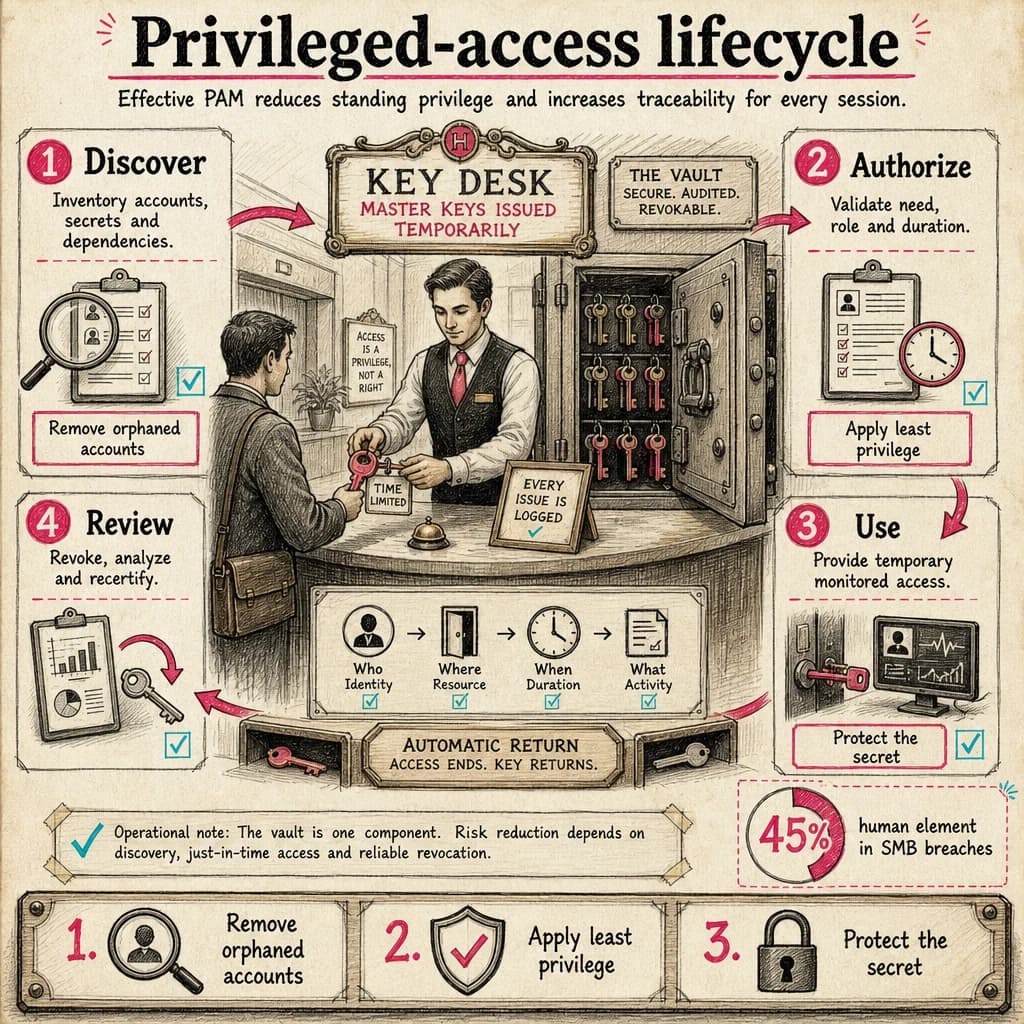
Privileged Access Management controls accounts and sessions capable of changing sensitive systems. It combines discovery, secret vaulting, just-in-time access, approval, recording and monitoring to reduce standing privilege and improve accountability.
human element in SMB breaches
The SMB analysis in the 2026 DBIR attributes a human element to 45% of observed breaches. Defense must combine process, identity, email controls and reporting.
Verizon — 2026 Data Breach Investigations ReportPrivilege is broader than administrator accounts
Include human admins, service accounts, SSH keys, API secrets, emergency accounts and cloud roles. An inventory limited to Active Directory misses the hardest credentials to rotate.
For every privilege, map owner, purpose, target, authentication and rotation. Ownerless accounts are an immediate priority.
Design the access experience
Separate daily and privileged identities, require strong authentication and grant access for a specific target and duration. Approval should reflect risk: automated for controlled routine work, stronger for critical assets.
Design break-glass access before an outage. Protect, test and monitor emergency accounts and review every use.
Rotate service identities safely
Before rotation, identify dependencies, owners and deployment method. Blind rotation can stop production; never rotating leaves permanent exposure.
Prefer managed identities and short-lived secrets where available. Otherwise automate distribution gradually and watch for old-secret use.
Detect risky privileged use
Correlate PAM sessions with target and identity logs. Off-hours access, rare commands, data transfer or emergency-account use deserves review.
Measure standing privilege removed, ownerless accounts, rotation coverage and revocation time—not only accounts stored in a vault.
Operational decision matrix
| Stage | Question to resolve | Expected outcome |
|---|---|---|
| Discover | Inventory accounts, secrets and dependencies. | Remove orphaned accounts |
| Authorize | Validate need, role and duration. | Apply least privilege |
| Use | Provide temporary monitored access. | Protect the secret |
Real objective
The vault is one component. Risk reduction depends on discovery, just-in-time access and reliable revocation.
The right control level depends on context, exposed assets and business impact: document assumptions, measure the outcome and reassess after every material change.
Frequently asked questions
Is a password vault enough?
No. PAM also covers assignment, duration, approval, sessions, rotation and detection.
What is just-in-time privilege?
Privilege is granted only for the necessary task and duration, then removed automatically.
Where should PAM implementation start?
Start with access to critical assets and ownerless accounts, using a tested operational journey.
Official sources
Achraf Hachimi
CISSP-certified Senior SOC / CSIRT Engineer specializing in Incident Response, Threat Hunting and Detection Engineering. Eight years of experience in critical environments with Splunk ES, Microsoft Defender XDR, SentinelOne and Cybereason.