
Many markets continue to hire cybersecurity professionals, but “shortage” does not mean automatic employment. Demand clusters around specific roles, industries, technologies and levels; demonstrable experience and operational understanding matter.
projected U.S. information-security analyst growth
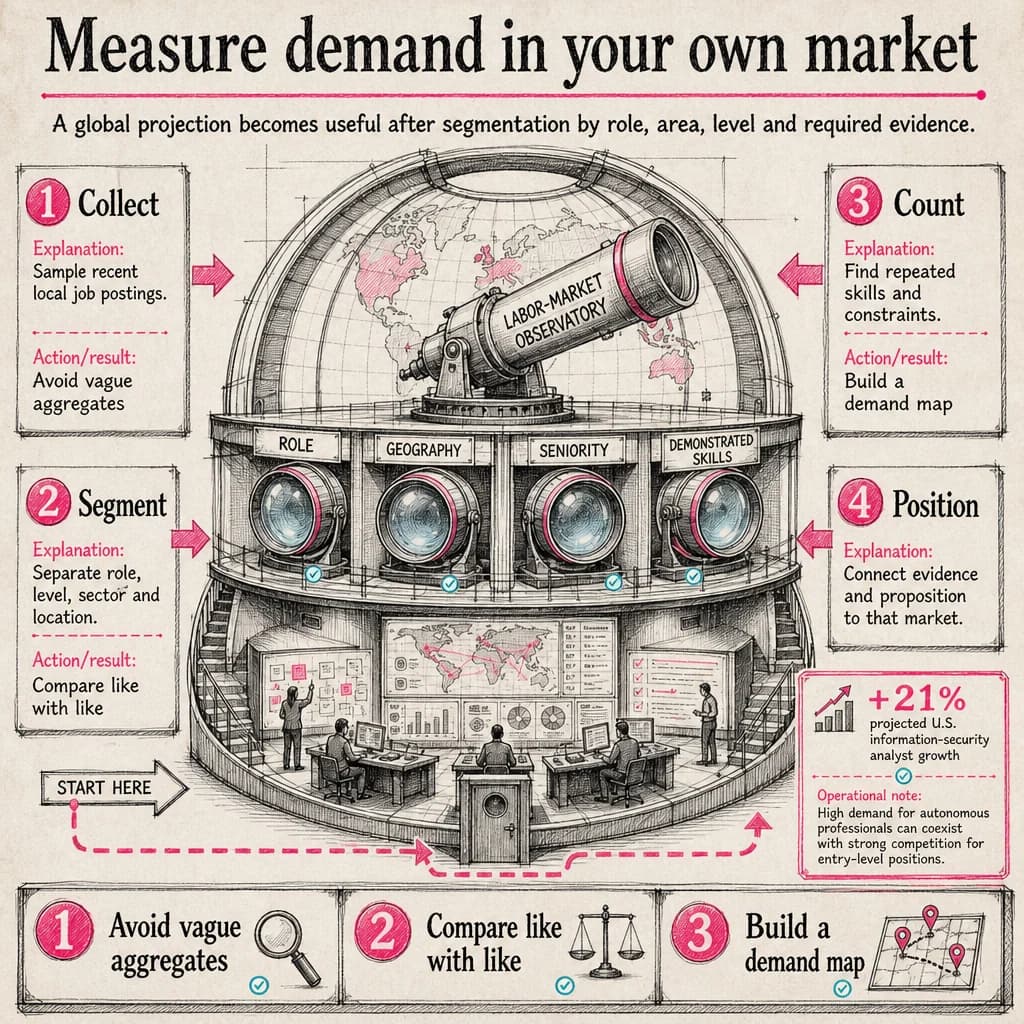
The BLS projects 21% growth from 2025 to 2035, with about 14,100 openings per year. This is a U.S. indicator and should be paired with local job-market evidence.
U.S. BLS — Information Security AnalystsA global number does not describe your market
National projections aggregate different realities. A junior SOC analyst in Paris, IAM architect in Casablanca and remote cloud specialist face different volumes and criteria.
Track local postings for several weeks: title, tasks, seniority, languages, clearance, onsite needs and technology. Repetition creates an actionable map.
Why shortage and entry-level difficulty coexist
Employers need autonomy in sensitive systems while beginners mostly offer knowledge. The missing bridge is evidence of practice, decision explanation and exposure to realistic constraints.
Junior titles may require system, network or cloud foundations. These skills are not a detour; they make security applicable.
Evaluate a specialty before investing
Group fifty postings, count requested skills and speak to people doing the role. Compare the effort to build credible evidence: SOC lab, IAM review, threat model or risk package.
Avoid paths promising a job through one tool. Tools change; diagnostic, communication and operating skills transfer.
Position with a clear proposition
State the role, problems you can solve, evidence and availability. A portfolio should reveal your reasoning level and deliverable quality in minutes.
- Measured local market
- Precise target role
- Adjacent foundations
- Relevant proof
- Targeted professional network
Operational decision matrix
| Stage | Question to resolve | Expected outcome |
|---|---|---|
| Collect | Sample recent local job postings. | Avoid vague aggregates |
| Segment | Separate role, level, sector and location. | Compare like with like |
| Count | Find repeated skills and constraints. | Build a demand map |
Read shortage with nuance
High demand for autonomous professionals can coexist with strong competition for entry-level positions.
The right control level depends on context, exposed assets and business impact: document assumptions, measure the outcome and reassess after every material change.
Frequently asked questions
Is cybersecurity oversaturated?
Some junior segments are highly competitive while specialized skills remain scarce. Analyze the exact role and location.
Which field has the most demand?
It changes by market and time. Measure local postings instead of relying on a generic global ranking.
Does a certification guarantee a job?
No. It may help screening, but practical proof, foundations and role fit remain decisive.
Official sources
Achraf Hachimi
CISSP-certified Senior SOC / CSIRT Engineer specializing in Incident Response, Threat Hunting and Detection Engineering. Eight years of experience in critical environments with Splunk ES, Microsoft Defender XDR, SentinelOne and Cybereason.